Showing posts with label epperson. Show all posts

Sunday, November 23, 2014

Mayflower ancestry and what have you

Today I finally had a moment to satisfy the vague curiosity I had been feeling about my Mayflower ancestors in anticipation of Thanksgiving. My Pilgrim line and Nate's both come from the same child of Elizabeth Tilley and John Howland, but I couldn't remember exactly which child or how it came down to me. I knew the Howlands came from my mom's side, and I thought through the Eppersons, but there are still about 14 zillion possibilities of direction even within those parameters. It's times like those that this blog really earns its keep. Its keep is exactly zero dollars and minimal effort, so you should be pretty relieved that it's worth it. 

I clicked on the Mayflower label, my Mayflower post came up, and I refreshed my memory ever so slightly. That Mayflower post was worth exactly the zero dollars it earns; it was so sketchy about the directness of the line that it took me about twenty minutes of looking at my family tree to find the link. But I found it!
See that Ammi Chipman in the very bottom right? That is the brother of Nate's ancestor, and their dad was the Howlands' grand-something-son. It is because the daughters of that line are my ancestors that I couldn't find the line. They turn from Chipmans to Simmonses to Atkinsons so fast I missed them the first few times I looked. Eventually, as I mentioned in the Mayflower post, my great-grandma Irva Shurtleff Epperson was born. 

Funnily and strangely, as coincidences are, I found a John Carver in my line during my search who was born in Plymouth, Massachusetts in 1661. (Cue the laugh track.) It's funny because John Howland, my Pilgrim man, came on the Mayflower to Plymouth as a servant to the Governor named John Carver--the guy who wrote the Mayflower Compact. They came (as you will remember or Wikipedia will remind you) in 1620, so this John Carver I'm related to is clearly not the same John Carver, and it's really not remarkable since both those names were fairly common in England just then (and now, and always, I assume). But it is a fun coincidence and it gave me a couple minutes' research to do.

The moral of this story is, what's the point of all this? I know, that's not even a moral! I can't remember who came from where and when, and I mix up their stories, and I forget which pioneers came from which pilgrims, and I get confused when Swedish ancestors move to Copenhagen, Denmark before the emigrate (that one sent me on a convoluted tangent today), and to make matters worse, it all comes out a little confusedly and boring when I write it up here. I think I should take a writing lesson from Bill Bryson on how to relay lots and lots frankly useless facts in a way that makes them sound amusing and even potentially worthwhile. Now, now, don't worry; the actual reason I do any research into my family history is just for my personal edification. I like doing it, and to be honest I am a little embarrassed to even say it's "research," because I don't uncover anything new. It's interesting to me, even if there is no visible point to it. It's better than building ships in bottles or giant lego cities, right? (Correction--building ships in bottles is awesome and now I can't stop thinking about how much I want a ship in a bottle. Maybe a mini Mayflower, for the Howlands sake!)

Wednesday, October 15, 2014

"When you read a book as a child, it becomes part of your identity in a way that no other reading does."

Kathleen Kelly from the movie You've Got Mail has about twenty boatloads of one-liners, and that one about reading is one of her truest. I don't presume that Toby and Sue will grow to have enormous significance in my kids' lives, but these books are some of Calvin's favorites lately. I am grateful to have them, and to know that Calvin's great-grandma Patti read them and probably laughed at Sue's funny lopsided dress hems and the children's idea that their mother would rather have wild baby bunnies for her birthday than a bouquet of flowers.


I have tried to collect several of the really significant books from my early childhood and youth, such as Hop on Pop (a classic!), Alexander and the Terrible, Horrible, No Good Very Bad Day, and The Witch of Blackbird Pond. I don't yet have any Babysitters Club, but I've got about a truckload of Nancy Drew, and by the time my dad's done gathering them, I'm sure we'll have them all. This is not to say that my kids will be interested in reading any of these obviously superior books, however; I know of my mom's distinct appreciation for the "girl and her horse" genre, absolutely zero of which ever interested me. (That seems a shame to me now, because it is such a charming genre, but at the time they would have been age-appropriate for me I couldn't be persuaded to even go near them.)

I would really love to know the significant books in my predecessors' lives, the further distant the more so. What were yours?

Wednesday, July 23, 2014

O Pioneer: Shurtliff and Atkinson

As I mentioned, Familysearch.org compiled a list of "my" "ancestral" "pioneers." But, well, I couldn't find all of them in my actual family tree. I'm working on that, but I did find that a certain Luman Shurtliff (on my mom's maternal side) crossed the plains with his family, including a son named Noah Luman Surtliff (who is next in the line to me) in 1851 with the Easton Kelsey Company. One lead to follow!

*Later*

Make that two leads: Noah L Shurtliff, who I mentioned above, is my great-grandma Epperson's grandpa, and her other grandpa named William Atkinson* also crossed the plains with the Mormon pioneers. In fact, he led his own company in 1853, the William Atkinson Company. Good one, Will! Along the way, according to his memory, he met lots of friendly Indians and buffalo, or at least the Indians were friendly.

He also "traveled with the mail" from Salt Lake to San Bernadino and back in 1856 with the John McDonald Company. Just him and three buddies, hanging out with the mail? Probably not but I don't know the details. I, of all people, could understand this, considering how much I love mail, but I think there must be more to the story than that. He is also listed as traveling with two other wagon companies, and also the Rescue Companies who were sent to bring in the Martin and Willie Handcart companies in the fall of 1856, as well as two wagon companies at the same time. It isn't clear which company he was sent to help, but the story of the stranded companies breaks my heart every time I hear or think of it.

I'm so glad to know about Mr. Atkinson. My kids are for sure going to hear about this one.

*Also, just to make more connections, this William Atkinson had a son, Thomas, who married into my path to the Mayflower ancestors of Elizabeth Tilley and John Howland. His wife's name was Ruth Simmons. Ruth's mom was a Chipman, which is the line that connects to the common ancestor Nate and I have (Amos Chipman).

Monday, July 7, 2014

april showers bring mayflowers

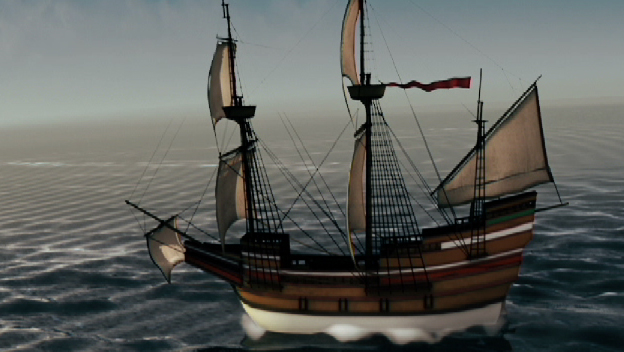
Thirteen generations back, two of my ancestors were aboard the Pilgrim ship Mayflower. They didn't know each other at the time; Elizabeth Tilley was barely a teenager during the crossing, 13 years old and coming with her parents. John Howland was a servant to Governor John Carver, and was in his early twenties. They married four years later and now (400 years later) have millions of descendants, thanks to their own ten kids. Several US Presidents and the Prophet Joseph Smith came from the Howlands' line, and so did my husband Nate.
Image from history.com
Elizabeth Tilley has been known to join his family for Clark Thanksgiving Day celebrations and tell the family the story of the Pilgrims' journey to Plymouth aboard the Mayflower. John Howland, who would be her husband, fell overboard on the journey during a storm, and Elizabeth Tilley would regale the family with the tale of frigid water, a man nearly lost at sea, and salvation by halyard. Either Grammy (Marilyn Clark) or Trudy would always happen to be absent during these visits, much to their dismay. As soon as Elizabeth Tilley would leave, Grammy would return from her Very Important Errand, having just missed the story, but in time to join the family in listing their blessings on the corn kernels left on their dinner plates.

The actual Pilgrims probably had little more than corn kernels to eat their first winter, and nearly half of them died before spring. Elizabeth and John were lucky, hardy and blessed. John signed the Mayflower Compact and the two of them raised their ten children to adulthood in their newfound homeland.

The Howlands' great-great grandson Amos Chipman is where my line and Nate's line converge. He and his wife Sarah had two sons, Barnabas and Ammi. (It appears that modern parents aren't the only ones to construct imaginative baby names, when you compare them to early New Englanders!) The family had moved to Connecticut by this time, and the two sons seem to have married sisters: Beulah Evarts and Sarah Evarts. Barnabas and Beulah ended up in New York, whereas Ammi and Sarah moved to Ontario, Canada. Both lines converted to the Mormon church two generations later and found their way to Utah. Nate's line is the Barnabas/Beulah line, and they settled in American Fork, Utah. Eventually Christa Mix Christensen was born there, and became the mother of Nate's grandma, Marilyn (the Elizabeth Tilley proxy). My line went to Rexburg, Idaho, then Ogden, where my maternal great-grandmother Irva Shurtleff Epperson was born. I know it's not really relevant, but I like that I have lived in both American Fork and Rexburg, too.
Irva Shurtleff Epperson and my grandmother, Patti
I haven't yet been to Plymouth, Massachusetts, however. I'd like to go see the monument there and get a feeling for the place those Pilgrims saw from the ship their first freezing, sickly, hard winter. I'd like to touch the water where the bow of the Mayflower hit ground. I am proud of them for creating a new life there in New England; really, just for living through it. When I think Mayflower Pilgrims, I think brave, strong, hardworking, steadfast, and other positive, sturdy adjectives. However, I know the Puritans could also use that diligence for stubborn narrow-mindedness. Many of my ideas of early New England life come from fiction, such as the extremely wonderful novel Witch of Blackbird Pond and the rather frightening play The CrucibleThe Crucible portrays bits of the Salem Witch Trials, which of course wasn't the brightest moment for the new Colonists--not to mention their treatment of Native Americans and their reputation of having no tolerance for fun or beauty or even anything moderately amusing. Since the Howlands and their children haven't specifically been mentioned in any of those events, however, I am free to give them the benefit of the doubt and focus on their legacy of ground-breaking hard work.