Showing posts with label pioneers. Show all posts

Sunday, November 23, 2014

Mayflower ancestry and what have you

Today I finally had a moment to satisfy the vague curiosity I had been feeling about my Mayflower ancestors in anticipation of Thanksgiving. My Pilgrim line and Nate's both come from the same child of Elizabeth Tilley and John Howland, but I couldn't remember exactly which child or how it came down to me. I knew the Howlands came from my mom's side, and I thought through the Eppersons, but there are still about 14 zillion possibilities of direction even within those parameters. It's times like those that this blog really earns its keep. Its keep is exactly zero dollars and minimal effort, so you should be pretty relieved that it's worth it. 

I clicked on the Mayflower label, my Mayflower post came up, and I refreshed my memory ever so slightly. That Mayflower post was worth exactly the zero dollars it earns; it was so sketchy about the directness of the line that it took me about twenty minutes of looking at my family tree to find the link. But I found it!
See that Ammi Chipman in the very bottom right? That is the brother of Nate's ancestor, and their dad was the Howlands' grand-something-son. It is because the daughters of that line are my ancestors that I couldn't find the line. They turn from Chipmans to Simmonses to Atkinsons so fast I missed them the first few times I looked. Eventually, as I mentioned in the Mayflower post, my great-grandma Irva Shurtleff Epperson was born. 

Funnily and strangely, as coincidences are, I found a John Carver in my line during my search who was born in Plymouth, Massachusetts in 1661. (Cue the laugh track.) It's funny because John Howland, my Pilgrim man, came on the Mayflower to Plymouth as a servant to the Governor named John Carver--the guy who wrote the Mayflower Compact. They came (as you will remember or Wikipedia will remind you) in 1620, so this John Carver I'm related to is clearly not the same John Carver, and it's really not remarkable since both those names were fairly common in England just then (and now, and always, I assume). But it is a fun coincidence and it gave me a couple minutes' research to do.

The moral of this story is, what's the point of all this? I know, that's not even a moral! I can't remember who came from where and when, and I mix up their stories, and I forget which pioneers came from which pilgrims, and I get confused when Swedish ancestors move to Copenhagen, Denmark before the emigrate (that one sent me on a convoluted tangent today), and to make matters worse, it all comes out a little confusedly and boring when I write it up here. I think I should take a writing lesson from Bill Bryson on how to relay lots and lots frankly useless facts in a way that makes them sound amusing and even potentially worthwhile. Now, now, don't worry; the actual reason I do any research into my family history is just for my personal edification. I like doing it, and to be honest I am a little embarrassed to even say it's "research," because I don't uncover anything new. It's interesting to me, even if there is no visible point to it. It's better than building ships in bottles or giant lego cities, right? (Correction--building ships in bottles is awesome and now I can't stop thinking about how much I want a ship in a bottle. Maybe a mini Mayflower, for the Howlands sake!)

Thursday, September 4, 2014

Mink Creek


 In Mink Creek, Idaho there is a tiny settlement and a tiny cemetery. Nate's forefathers Rasmus Christian Petersons Sr. and Jr. were some of the founding settlers of that picturesque spot between Preston and Bear Lake. We stopped to say hi on our way to the lake on Labor Day.
Finally we have a cool headstone in the family! (Uh, well, since 1916) RC Peterson, you have a nice view.

Monday, August 18, 2014

Betsy

Last week I took out Hannah's Ledger Book and decided to start at the very beginning (a very good place to start). First is an entry written in Logan, Utah from October 1932 which she went back and wrote on a blank page many years after the "first" journal entry, which was in 1921. The second sentence says, "Today I went to Smithfield it is about 7 miles from here."

It just so happens that I live in Smithfield, 7 miles from there! I was more than a little surprised, I say. I reread the sentence and then kept on going for more surprises. "My Aunt Betsy lives there, Mother's only sister she ever had, and she is 90 years." I didn't know Aunt Betsy lived in my town in 1932! I really had no clue there was even an Aunt Anything who lived Anywhere in 1932, although I'm not sure why I was so surprised to find there was. That's actually one of my favorite things about the family history learning I've been doing lately: all the genuine surprise I get out of it. It's not often that I'm really surprised by anything. But family history surprises are generally like finding a dollar in your pocket-- very welcome, maybe even more so because you weren't just sitting around hoping they would happen.

Anyway, I read the rest of the entry which tells about how Betsy and the sisters' parents came to be in Smithfield.
Here she is, good old Betsy, still in Smithfield. Calvin posing with binoculars next to her.
Hannah had asked Aunt Betsy about her life and had written it down straight away, which was very decent of her to do. The summary I will give of the summary Hannah gave begins in Sweden, in the girls' youth. The Mormon missionaries came to their town, and Cecelia listened and believed. It just so happens that Betsy did too, and although their parents weren't 100% behind the decision they allowed the girls to be baptized, but they had it done at night to keep it a secret since there was a lot of persecution of converts to the church in Sweden at the time.

Both girls went to work in Copenhagen, ostensibly to earn money to come to Utah but also, it seems, to escape their father's wrath. He wasn't particularly kind-hearted. As Hannah notes,  in the old country "they thot if they did not whip their children the children would not be good, so I am sorry to write what Betsy and my mother have told me, how cruel their Father was." She then tells about how he whipped Cecelia nearly to death for defying one of his superstitions about a cow exiting the barn a certain way (which I didn't completely understand), and how he made their half-brother sit outside with a wet sheet around him regardless of the weather if he wet the bed. So. Not exactly a Hallmark card kind of guy. 

Cecelia had enough money to go first, and after she wrote and said it was safe, Betsy, Lars and Magnel (Father & Mother) came, too in April 1864 and were at sea 9 weeks. They walked across the plains with a cow they had bought. When they first saw the Salt Lake Valley, the Teamsters said to Betsy, "Well here is Zion," to which she replied, "Well here is nothing but sage brush." Too true, I'm afraid, but the Teamsters gave her a Sunday School answer that she couldn't argue with: "Zion is just what you make it.

And so the Teamsters told the family to go wherever they had friends or family, and they went to Smithfield, though what family they already had here I have yet to discover. Years later, Betsy and Cecelia's brother Swen came down from Smithfield to visit Cecelia, Hakan and their family. He convinced the Anderson family to come up to Cache Valley with him where they lived in Hyrum for over six years before they moved up to the Snake River Valley in Idaho to get ahold of more land for all the boys (Hannah says).
My little family and I went to the cemetery when I discovered that Ma & Pa Swenson never left Smithfield, and Betsy (her name was actually Bengta) did in fact live here until she died, and was also buried here. Nate thought it was cool that my family has roots here, too. In fact they go back even further than his, which I was (you guessed it) VERY SURPRISED to find out.

Thursday, August 7, 2014

More August birthdays / a book

The first thing we did on Norah Jocelyn Peterson's first birthday is go to the Rexburg, Idaho cemetery with my dad, whom she calls Papa. (Or at least presumably she will, once she speaks.)
Happy birthday, baby! 
Calvin, Papa, Norah

Calv, me, Norah

We went to see the headstones of Hogan (or was it Hakan?? the headstone said Hogan) and Cecilia Anderson because I never have and they were right there under my nose the whole time my parents lived in Rexburg. They are moving this month, so I wanted to go while I could. It was rainy and cool, which is of course the best kind of cemetery weather there is.

My dad added to my story about those pioneer ancestors (from here) with a little bit more detail. Hogan/Hakan went to Manti after he arrived in Utah with his cousin when they were lads. They had both been sent from Sweden by their families who couldn't afford to come or take care of them. It is also interesting that Cecelia's friend, who Hakan married first but she died, was named Hannah, and then the couple named their first child Hannah.

And so, here is an old book that belonged to Hannah that is so lovely that I almost can't stand it. It's slightly less than 100 years old, but that pattern on the front is so pretty and to tell you the truth trendy right now that I just like to stare at it.

Hannah Anderson Johnsen was the grandma who raised my Grandma Ada Stricklan in Shelley, Idaho after her mom died. (There is also a picture of Hannah in that post about Hakan and Cecelia as pioneers.) My dad has kept Hannah's journal and ledger book, which has an entry as early as 1918. The journal part begins in 1921. She recounts her engagement and marriage, sporadically writes about her children and grandchildren's lives and prices of crops over the years, since they were farmers. The last entry is in 1940 and is hardly legible. I have read bits of it, but it's hard to read because it's written in Hannah's beautiful handwriting and the pages have faded and some are water damaged and also I get distracted really easily by the amazing pattern on the front cover and the terrifying recipe for soap in the back. I will share a lot of these things as I go, you can be sure.

Monday, July 28, 2014

Speaking of which: Ada's words about Cecelia Andersen

"Speaking of which" is something we sometimes say when we weren't exactly, which is the way I use it here (and, incidentally, the way my 3-year-old uses it to amuse grandparents and anyone who will listen to him). I found in my Grandma (Ada) Stricklan's compilation of writing an essay where she talks about the same Cecelia I spoke of in the Hakan Andersen pioneer post. She spelled the name "Cecilia" instead of "Cecelia," which actually seems more natural to me, but the official records aren't in accord on the point of spelling, so I don't know which way is correct. Does anyone care? It probably doesn't matter.
Ada, in what is labeled as 1957, but I feel like it must be later than that. What do you think?

Before we get there, though, it just struck me that what I was reading was an Idaho Writer's League assignment in 1975. Who knew there was such a thing as an Idaho Writer's League, Arco Chapter? I had read Grandma's writing before, but didn't realize she was part of a League of extraordinary writers. It is funny and strange what people do, don't you think, to write what they think needs to be written?

But anyway, back to speaking of which, in an essay about grandmothers, my grandmother wrote about Cecilia:

There was once a girl named Cecilia. She lived in Sweden. When she heard the Gospel she knew it was true. After awhile she came to America. She wanted to live with the Saints. Her father told her, "If they do not kidnap you or murder you, you can write and tell us and we will all come."*  Cecilia walked to Salt Lake City Valley from St. Louis. Along the way she was weary and hungry. She met and married a good man. She had children, grandchildren and great grandchildren. She loved her family. She said, "I would like my children to remember their heritage and the hard-ships that their ancestors wen through to get to this country and become established...and remember the reason that brought them here in the first place, to remember these things and to be better men and women for it."

*I wonder if Cecelia's father had read the Sherlock Holmes story A Study in Scarlet, which portrays the Mormons as kidnapping, murdering types. Though I guess that's not possible, since it wasn't published until 1887, which was long after Cecelia came. 


Wednesday, July 23, 2014

O Pioneer: Shurtliff and Atkinson

As I mentioned, Familysearch.org compiled a list of "my" "ancestral" "pioneers." But, well, I couldn't find all of them in my actual family tree. I'm working on that, but I did find that a certain Luman Shurtliff (on my mom's maternal side) crossed the plains with his family, including a son named Noah Luman Surtliff (who is next in the line to me) in 1851 with the Easton Kelsey Company. One lead to follow!

*Later*

Make that two leads: Noah L Shurtliff, who I mentioned above, is my great-grandma Epperson's grandpa, and her other grandpa named William Atkinson* also crossed the plains with the Mormon pioneers. In fact, he led his own company in 1853, the William Atkinson Company. Good one, Will! Along the way, according to his memory, he met lots of friendly Indians and buffalo, or at least the Indians were friendly.

He also "traveled with the mail" from Salt Lake to San Bernadino and back in 1856 with the John McDonald Company. Just him and three buddies, hanging out with the mail? Probably not but I don't know the details. I, of all people, could understand this, considering how much I love mail, but I think there must be more to the story than that. He is also listed as traveling with two other wagon companies, and also the Rescue Companies who were sent to bring in the Martin and Willie Handcart companies in the fall of 1856, as well as two wagon companies at the same time. It isn't clear which company he was sent to help, but the story of the stranded companies breaks my heart every time I hear or think of it.

I'm so glad to know about Mr. Atkinson. My kids are for sure going to hear about this one.

*Also, just to make more connections, this William Atkinson had a son, Thomas, who married into my path to the Mayflower ancestors of Elizabeth Tilley and John Howland. His wife's name was Ruth Simmons. Ruth's mom was a Chipman, which is the line that connects to the common ancestor Nate and I have (Amos Chipman).

Tuesday, July 22, 2014

O Pioneer: Hakan Andersen

Next on the "easy" pioneer list is Hakan Andersen. Of course, as with Nancy Naomi, it was really a couple whose story I knew, but in this one he is the main character for some reason, just as NN was the main character in her story. I'm not sure why this is, but nevertheless it's how I think of them.

The bad news here is also my motivation to learn more about family history: I thought I knew the story but now I'm not so sure. The Hakan Andersen Book would set me straight, but it resides at my parents' house (so mom, you may have to set me straight). Here's what I think happened.

Hakan (or Hogan) (or Haakan) (or about ten variations) crossed the plains as a young-but-not-that-young convert to the Church. When he arrived in Salt Lake, as a strong healthy man, he was asked to go back and help others across the plains. There he met a girl and fell in love with her...however, she was sick or something and died. I think. But the good news is that this girl had a friend! And she was Cecelia. And Hakan and Cecelia got married and had a family and moved to Idaho.

This is the lineage: Hakan and Cecelia had a daughter named Hannah, whose son Hakan Ostlin went by Ostlin and was my paternal grandma Ada's father. So in reverse, Me/Dave/Ada/Ostlin/Hannah/Hakan & Cecelia.

Hakan & Cecelia's family

Hannah Andersen, presumably before she married John Alfred Hanson
But listen here, I am not the only one who thought I would celebrate Pioneer Day by exploring my pioneer ancestors. Familysearch.org itself sort of stole my thunder by sending me a list of all of the pioneer ancestors I had, complete with company and any information they have on the person.  Holy smokes, that makes my aspiration to find out who my Pioneer ancestors are about 97% more likely to happen. Thanks, Familysearch. I don't know how I would have found out on my own; I really have a lot (or everything) to learn about family history.

So here is what Familysearch.org taught me. Hakan crossed in 1859 with the George Rowley Company. Cecelia Swenson crossed in 1863 with an Unknown Company. They were both from Sweden (but I already knew that one).

You can find your own Pioneer Ancestors on Familysearch.org too, I think. Do it! It's cool.

Sunday, July 20, 2014

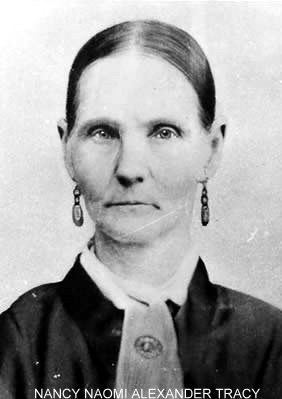
O Pioneer: Nancy Naomi

In honor of Pioneer Day, I have been thinking about my Mormon Pioneer ancestors. I have several; a few that I know of off the top of my head and a few that I don't know anything about. If I write about the ones I'm familiar with this year, it will give me something to write about next year, and a whole year to learn about the ones I don't know.

First and easiest of all is one who isn't my ancestor, but Nate's. Nancy Naomi Alexander Tracy wrote an autobiography (here), which is kept with the LDS records, and so bits of her story are often told on church documents as an example of an early convert and pioneer. There was an article about her in the Ensign in 2012 (here).
Her life is exactly what you think of when you try to imagine a pioneer woman. Early hardship in life taught her what to expect, and how to deal with, future troubles. Her dad died young and she was sent to live with her grandparents. They were good to her and she got some education, and learned how to work hard. She married her husband Moses really young, had ten kids, and named them long scriptural names like Lachoneus Moroni and Moses Mosiah.  She and Moses were present at the Kirtland temple dedication, went to Far West, Missouri, fought the militia there, and were then forced to leave Missouri by the infamous Extermination Order and went to Nauvoo, Illinois. She was present when the Relief Society was formed in 1842 and got her endowment in the Nauvoo temple. At least three of her children died before reaching adulthood. She and her family crossed the plains with a wagon train and settled near Ogden, Utah. Pretty comprehensive pioneer stuff.

Her son Helon Henry had a son named Helon Henry, and he had a daughter named Myrtle. Myrtle married Carl Clark, and their son Ralph Clark is "Gramspie" to us. Nate and I have some tablecloths that belonged to Myrtle and Carl--one with Carl's name written on a corner in permanent marker. We also have some myrtle growing next to our porch which we got from Nate's mom, who got it originally from Myrtle's house.
Myrtle and Ralph Clark, 1926
Nate has known about his Pioneer heritage all his life, thanks to the ties to Nancy Naomi Alexander Tracy. Every Memorial Day, rain or shine, the Clarks make their pilgrimage to the Ogden cemetery to visit the family gravesites, not least of which are the Pioneer Tracys. Every year, they collect pinecones (I'll write about pinecones another time) on the graves, say a prayer, and take photos. The photos have looked basically the same for the last 50 years, but that's not going to stop us from taking them every year!


The Ralph and Marilyn Clark family plus Carl, 1970-something

The Ralph and Marilyn Clark family, 2011

Melissa and Nate, 2011 with Nancy Naomi and Moses Tracy's headstones in Ogden